Mikhail Soutchanski
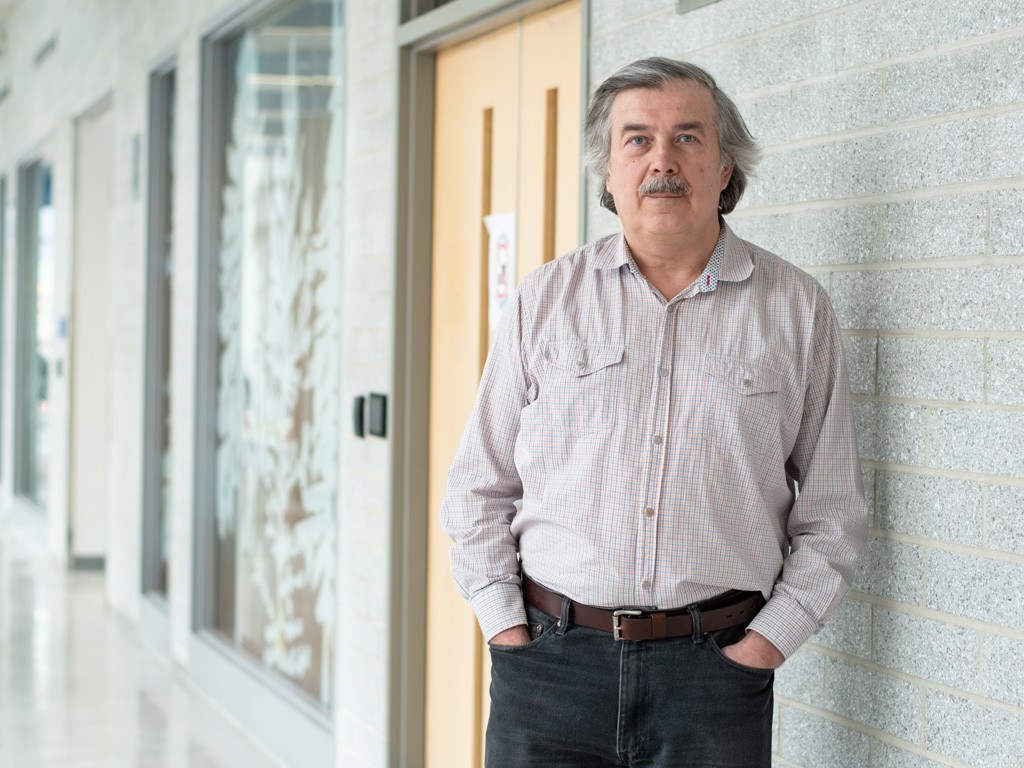
Mikhail Soutchanski, full professor
PhD in Artificial Intelligence, University of Toronto, Canada.
Email: Thank you for not sending me email!
Exception: if you would like to discuss common research interests over Teams or Zoom,
then you can email me MyFamilyName (at) protonmail (dot) com
Office:
245 Church Street, room ENG275 (NE corner, the 2nd floor)
Computer Science is located in George Vari ENG building.
The Department of Computer Science is part of the
Faculty of Science.
Phone: (416) 979 5000 ext 55-7954 (leave voicemail)
General enquiries:
ask (at) cs.torontomu.ca
or Ms. Erin Knight (416) 979-5000 ext.55-7410 (55-7411)
Mailing address:
245 Church Street, ENG281
Department of Computer Science
Toronto Metropolitan (formerly Ryerson) University (TMU)
Toronto, Ontario, M5B 2K3, Canada
|
|
Some of my
Publications
Research interests
- I'm interested in
Reasoning about Actions and Change.
I explore several computational tasks such as correct reasoning about actual causes, and
automated real-world planning with informative domain independent heuristics
that facilitate search for a correct plan.
More specifically, I'm interested in planning on the level of action schemes
in the open world with incomplete knowledge when some of the objects remain unnamed,
when the objects can be created or destroyed at planning time,
and when some action parameters can vary over infinite domains.
Also, I'm interested in domain independent temporal
automated planning
in mixed discrete-continuous dynamical systems with relational structure.
Recently, my research focused on the case when all discrete actions initiate and/or terminate
continuous processes and thereby stitch together continuous trajectories over time.
The minimum time problem is how to compute a sequence of actions and a schedule
when they have to be executed to reach a specified goal state as soon as possible
while satisfying numerical constraints in action preconditions.
Previously, finite state
hybrid automata have been explored to solve
similar class of computational problems,
but some important real-life mixed discrete-continuous dynamical systems are actually relational,
since their states are not atomic, but have complex internal structure.
The focus of my research is on general, sound, domain-independent, efficient
problem solving methods that can work over infinite domains and
can approximate (sometimes) plans for mixed discrete-continuous dynamical systems.
This research has several applications, e.g., how to integrate Task and Motion Planning (TAMP) in robotics,
as well to health and medical sciences.
- (Past) multi-disciplinary research:
I was interested in solving the organic chemistry synthesis problem using a variety
of techniques from automated planning.
More generally, I was interested in applying automated planning methods to facilitate discovery
in health and natural sciences.
-
Reasoning about actions and events with applications to generic problem solving.
I was developing modular and taxonomic representations that can facilitate implementing
large-scale logical theories for reasoning about effects of actions/events.
International students:
Unfortunately I am unable to respond to emails about graduate admission or possibility
of working with me. Please contact the School of Graduate Studies or
the CS Graduate Program Assistant.
If you have been admitted to TMU, feel free to reach out if you're interested
in discussing research opportunities in my group, or in a joint research project.
I would strongly recommend to browse my recent research papers before
you contact me and write why do you think our research interests match well.
If you have published research papers yourself, inform me.
Recent Teaching
CPS822/CP8314
Artificial Intelligence 2 : Dynamical Systems in AI.
Advanced undergraduate / graduate course (Winter 2027).
CPS 721:
Artificial Intelligence 1 , an undergraduate course (Fall 2026).
Past Teaching
CPS 824 / CP8319:
Reinforcement Learning (Winter 2026).
A graduate / advanced undergraduate course.
CPS 40A/B:
Undergraduate Thesis , a two-term research oriented course (Fall 2023 - Winter 2024).
Prerequisites: excellent programming skills, the grade "A" in CPS721 and GPA higher than 3.5
CPS 815 / CP8201:
Topics in Algorithms , an undergraduate course (Fall 2023).
CP8310/8311:
Directed Studies in Computer Science (Winter 2022),
a graduate course.
CPS 125:
Digital Computation and Programming (Winter 2017), an undergraduate course.
CPS 616:
Analysis of algorithms , an undergraduate course (Winter 2014).
CP8201:
Algorithms and Computability, (Fall 2013),
a graduate course.
CPS603:
Foundations of Semantic Technologies
(Winter 2011), an undergraduate/graduate course.
WWW links
Quotes
"In theory, theory and practice are the same. In practice, they are not."
"The proper method for inquiring after the properties of things is to deduce them from experiments."
"In questions of science, the authority of a thousand is not worth the humble reasoning of a single individual"
"An error does not become truth by reason of multiplied propagation, nor does truth become error because nobody sees it"
"The greatest enemy of knowledge is not ignorance, it is the illusion of knowledge"
"The truth is simple. If it was complicated, everyone would understand it."
"There is nothing more practical than good theory"
"No more causes of natural things should be admitted than are both true and sufficient
to explain their phenomena." (Rule 1)
"Therefore, the causes assigned to natural effects of the same kind must be,
so far as possible, the same." (Rule 2)
"We learn more and more about less and less, and less and less about more, until we know everything about nothing and nothing about everything."
"When you have eliminated the impossible, whatever remains, no matter how improbable, must be truth."
"Imagination is more important than knowledge. For knowledge is limited to all we now know and understand, while imagination embraces the entire world, and all there ever will be to know and understand".
"Quid est veritas?" ("What is truth?")
"Thoughts without content are empty, and intuitions without concepts are blind."
"The grand aim of all science [is] to cover the greatest number of empirical facts by logical deduction from the smallest possible number of hypotheses or axioms."
"Science is built up of facts, as a house is built of stones; but an accumulation of facts is no more a science than a heap of stones is a house."
"The expressive power of first order logic determines not so much what can be said but what can be left unsaid."
"Mathematics is not a science. It is a tool provider to help find adequate languages for natural sciences."
"Mathematics is a part of physics. Physics is an experimental science, a part of natural sciences. Mathematics is the part of physics where experiments are cheap."
"The Glass Bead Game is a mode of playing with the total contents and values of our culture; it plays with them as, say, in the great age of the arts a painter might have played with the colours on his palette."
"The difficulty lies not so much in developing new ideas as in escaping from old ones."
"When a measure becomes a target, it ceases to be a good measure."

Web mail
